When it comes to lighting your home, office, or commercial space, the initial purchase price is often the first thing people look at. And let’s be honest—LED strip lights can sometimes cost more upfront than a simple fluorescent tube or a pack of halogen bulbs.
But if you’ve been running your business or managing household expenses long enough, you know that the cheapest option upfront is rarely the cheapest in the long run.
So, how do LED strip lights really stack up against traditional lighting options like fluorescent, halogen, and incandescent? Let’s break it down across three key factors: energy efficiency, lifespan, and maintenance costs.
This is where LED technology shines—literally.
Traditional lighting types waste a significant portion of energy as heat. If you’ve ever touched a halogen bulb after it’s been on for five minutes, you know exactly what we mean.
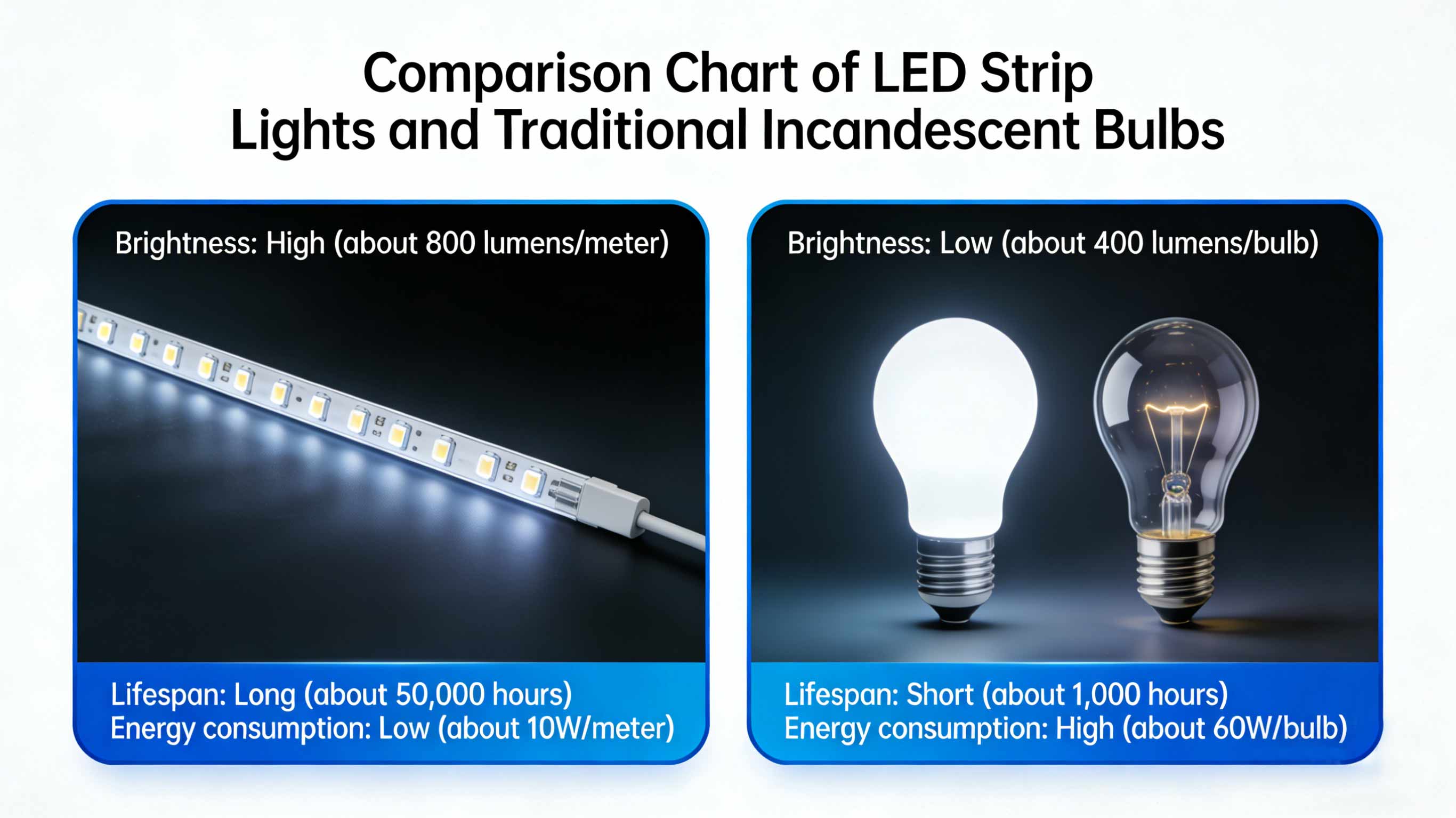
Here’s a quick comparison of energy consumption for producing roughly the same amount of light (measured in lumens):
| Lighting Type | Wattage (for equivalent brightness) | Energy Waste (as heat) |
|---|---|---|
| Incandescent | 60W | ~90% |
| Halogen | 42W | ~80% |
| CFL (Compact Fluorescent) | 14W | ~70% |
| LED Strip | 9W – 12W | <10% |
A 5-meter LED strip running at full brightness typically consumes between 24W and 72W total—enough to illuminate an entire room with less energy than a single incandescent bulb.
Translation for your wallet: Switching from incandescent to LED can reduce your lighting energy bill by 75–80%. If you’re lighting a retail store, restaurant, or large home, those savings add up to hundreds of dollars per year.
One of the most frustrating things about traditional lighting is the constant replacement cycle. Fluorescent tubes flicker and dim over time. Halogen bulbs burn out when you least expect them to.
LED strips operate on a completely different principle. Instead of a filament that burns out or gas that degrades, LEDs use solid-state technology that gradually dims over an extremely long period.
| Lighting Type | Average Lifespan (Hours) | Replacement Frequency (8 hrs/day) |
|---|---|---|
| Incandescent | 1,000 – 2,000 hrs | Every 4–8 months |
| Halogen | 2,000 – 4,000 hrs | Every 1–1.5 years |
| Fluorescent (CFL/Tube) | 8,000 – 15,000 hrs | Every 3–5 years |
| LED Strip | 30,000 – 50,000+ hrs | 10–17 years |
A quality LED strip (using high-quality SMD chips like 2835 or 5050) can last well over a decade with daily use. For businesses, this means dramatically lower maintenance costs—no more paying someone to change hard-to-reach bulbs every few months.
Traditional lighting is rigid. You install a fixture, and that’s where the light stays. Want to change the layout? You’re looking at rewiring, patching drywall, or hiring an electrician.
LED strip lights offer something traditional lighting simply cannot: flexibility.
Cut-to-length: Need exactly 2.3 meters for a custom cabinet? You can cut most LED strips at designated marks.
Adhesive backing: Peel and stick. No junction boxes, no recessed cans, no structural changes.
Low voltage (12V/24V): Safer for DIY installation, especially in kitchens, bathrooms, and outdoor spaces.
Shapes and corners: With flexible PCBs and corner connectors, you can route light into spaces where traditional fixtures simply don’t fit.
If you’ve ever hired an electrician to install recessed lighting in a finished ceiling, you know the cost can easily run into the hundreds or thousands of dollars. With LED strips, that installation cost often drops to near zero.
When comparing lighting options, many buyers overlook one critical factor: color consistency and flicker.
Cheap fluorescent tubes often have poor color rendering (CRI below 80), making products, food, or merchandise look dull. Worse, old fluorescent fixtures can flicker—a known trigger for eye strain and headaches.
High-quality LED strips, especially those with CRI 90+, provide:
Consistent color across the entire run
Flicker-free operation (especially important for video production, retail displays, and home offices)
Dimming capability without buzzing or color shift
For businesses selling products online or in-store, good lighting directly impacts how customers perceive your merchandise. That’s not an expense—it’s an investment.
While not always a deciding factor for everyone, it’s worth noting that LEDs are far more environmentally friendly:
No mercury (unlike CFLs and fluorescent tubes)
Lower carbon footprint due to reduced energy consumption
Less waste in landfills because of dramatically longer lifespan
For companies with sustainability goals or eco-conscious customers, switching to LED lighting can be a meaningful part of your green strategy.
Let’s run a simple 5-year cost comparison for lighting a small retail display area (roughly 10 meters of continuous lighting, used 10 hours a day):
| Cost Factor | Fluorescent Tubes | Halogen Track Lights | LED Strips |
|---|---|---|---|
| Initial Purchase | $50 – $100 | $80 – $150 | $100 – $200 |
| Energy Cost (5 years) | $300 – $400 | $450 – $600 | $80 – $120 |
| Replacement Bulbs/Units | 2–3 replacements ($50–$100) | 5–8 replacements ($100–$200) | $0 (no replacements) |
| Installation Cost | Moderate (electrician) | Moderate (electrician) | Low (DIY possible) |
| Total 5-Year Cost | $400 – $600 | $630 – $950 | $180 – $320 |
Even though LED strips may have a slightly higher upfront cost, the total cost of ownership over 5 years is often half or less compared to traditional lighting.
If you’re renovating a space, opening a new store, or simply upgrading your home lighting, the choice is clear. LED strip lights offer superior energy efficiency, dramatically longer lifespan, lower maintenance costs, and installation flexibility that traditional lighting simply cannot match.
The upfront price tag might catch your eye, but the long-term savings—both in energy bills and in the time you spend changing bulbs—make LED strips the smarter investment.
Ready to make the switch? Browse our factory-direct LED strip collection, available in single color, RGB, RGBIC, and waterproof neon flex. Whether you need high-CRI strips for a retail display or energy-efficient tape for under-cabinet lighting, we have the right solution for your project.
Have questions about choosing the right brightness or power supply? Check out our technical guides or contact our team—we’re here to help you get it right the first time.

 Our Store


 IPv6 network supported
 English
 français
 español
 العربية
 한국의
한국의